
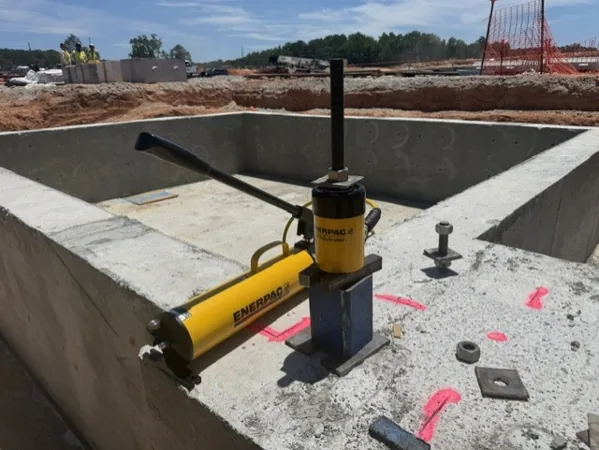
OSHA 29 CFR 1926.502(d)(15) requires fall arrest anchorages to support at least 5,000 pounds per employee attached — or be designed as part of a complete fall arrest system with a minimum 2:1 safety factor. This applies to all permanent anchor points used for personal fall protection: roof anchors, tie-off points, davit bases, parapet anchors, and horizontal lifeline anchors. Building owners are responsible for maintaining these systems, ensuring annual inspections, and recertifying anchors at intervals not exceeding 5 years per ANSI Z359.18.
Fall protection anchor testing is separate from IBC post-installed anchor testing. The IBC governs new construction anchor installations. OSHA governs the ongoing life of fall protection systems regardless of when they were installed or what building code was in effect. A building owner's obligation to test and certify fall protection anchors does not end when the construction project is complete — it continues for the life of the system.
The 5,000-Pound Requirement
OSHA 1926.502(d)(15) states that anchorages used for personal fall arrest equipment shall be capable of supporting at least 5,000 pounds (22.2 kN) per employee attached. The alternative is designing the anchor as part of a complete personal fall arrest system that maintains a safety factor of at least two over the maximum arresting force. In practice, most standalone anchor points are designed and tested to the 5,000-pound threshold because it's simpler than calculating system-level safety factors for every possible use scenario.
The 5,000-pound figure is approximately twice the maximum arresting force generated by a 220-pound worker in a 6-foot free fall — the standard OSHA test scenario per Subpart M Appendix C. This 2:1 margin accounts for real-world variables: heavier workers, longer falls within the permitted range, shock loading, and degradation over time.
Per Employee Attached
The 5,000-pound requirement is per employee. If two workers are tied off to the same anchor, it must support 10,000 pounds. If three are attached, 15,000 pounds. This is frequently overlooked on jobsites where multiple workers share anchor points. Each anchor must be rated for the maximum number of workers who will be attached simultaneously.
What Types of Anchors Require Testing?
All permanent anchorage points used for personal fall arrest, positioning, travel restraint, or rescue systems require testing and certification. This includes:
Roof Anchors
Single-point anchors installed on flat or sloped roofs for maintenance workers, HVAC technicians, and roofing crews. Both post-installed (epoxy or mechanical) and through-bolted systems.
Davit Bases & Sockets
Fixed base plates that accept removable davit arms for suspended scaffolding and window washing. Typically installed at roof edges or on parapet walls.
Parapet Anchors
Anchors installed into or through parapet walls at roof edges. Used for window washing, facade maintenance, and leading edge protection.
Horizontal Lifeline Anchors
End anchors and intermediate brackets for cable or rail horizontal lifeline systems. Every anchor in the system must be individually certified.
Tie-Off Points
Any designated attachment point for lanyards, self-retracting lifelines, or rope grabs. Includes eyebolts, D-rings, and engineered connection points.
Rescue System Anchors
Anchors designated for rescue operations — tripod mounts, retrieval system attachments, and confined space entry points.
Testing & Inspection Schedule
Fall protection anchors require three layers of verification: initial load testing after installation, annual visual inspections, and periodic recertification load testing. OSHA 1910.27(b)(1) requires certification at least every 10 years. However, ANSI Z359.18 recommends recertification not exceeding 5 years, and adhesive anchors specifically require load testing at 5-year intervals. Most fall protection companies and building owners follow the 5-year standard as industry best practice.
Post-Installation Testing
Every anchor load tested to 5,000 lbs (or the system design load) before the system is placed in service. Test results documented with anchor location, load achieved, and pass/fail determination. Performed under the supervision of a Professional Engineer.
Visual Inspection
A qualified person inspects every anchor for corrosion, cracking, deformation, loose fasteners, deterioration, and signs of impact or overload. OSHA 1910.66 requires a 12-month inspection cycle. Records must be maintained and made available to employers using the system.
Recertification Load Testing
Full load testing of every anchor per ANSI Z359.18. Adhesive anchors are specifically called out for 5-year testing intervals due to long-term bond degradation concerns — a direct legacy of the Big Dig epoxy anchor failure. All results certified by a Professional Engineer.
Building Owner Responsibilities
The building owner is responsible for maintaining fall protection anchor systems — not the tenants, not the maintenance contractor, not the window washing company. OSHA 1910.27(b)(1) requires the building owner to base information provided to employers on annual inspections and certification of each anchorage. This means the owner must ensure inspections happen on schedule, maintain certification records, and provide current documentation to any employer whose workers will use the system.
This is a significant ongoing obligation that many building owners are unaware of. A fall protection system installed during construction becomes the owner's responsibility the moment the building is occupied. If a window washer's anchor fails and their employer cannot produce current certification records, the building owner is exposed to OSHA citations and civil liability.
Recurring Revenue for Building Owners to Budget
Annual visual inspections and 5-year load testing are not one-time costs — they recur for the life of the building. Building owners should budget for these inspections as part of routine facility maintenance, the same way they budget for fire extinguisher inspections or elevator certifications.
5,000 Pounds vs. 2:1 Safety Factor — The Two Compliance Paths
OSHA gives two options for anchor capacity. Most projects use the 5,000-pound path because it's straightforward — test to 5,000 lbs, pass or fail. The 2:1 safety factor path requires a qualified person to design the complete fall arrest system and calculate the maximum arresting force, then prove the anchor supports at least twice that force. This second path can result in a lower required anchor capacity but demands more engineering analysis.
Per OSHA's interpretation letter dated February 8, 2011, the 5,000-pound requirement is based on yield strength of the supporting member — the load at which permanent deformation first begins. The anchor does not need to survive 5,000 pounds without any deformation; it needs to not yield below 5,000 pounds. This distinction matters for testing — proof load testing to 5,000 lbs with no permanent deformation is the acceptance criterion.
What Happens If You Don't Test?
OSHA violations for fall protection deficiencies are consistently among the most-cited standards every year. Failure to maintain certified anchor systems can result in OSHA citations, fines ranging from thousands to hundreds of thousands of dollars for willful violations, and — in the event of an accident — criminal liability and wrongful death civil suits. The cost of annual inspections and 5-year recertification is negligible compared to the exposure of operating uncertified anchor systems.
References
29 CFR 1926.502(d)(15)
The primary fall protection anchor requirement for construction. Anchorages must support 5,000 lbs per employee or maintain a 2:1 safety factor as part of a complete fall arrest system.
29 CFR 1926 Subpart M, Appendix C
Non-mandatory guidelines for personal fall arrest systems. Defines the 220-pound test weight, 6-foot free fall test scenario, and 2,520-pound maximum arresting force criterion.
OSHA Interpretation Letter — February 8, 2011
OSHA clarification that the 5,000-pound requirement is based on yield strength. Snaphooks and D-rings must meet 5,000 lbs without yielding; proof testing threshold for these devices is 3,600 lbs.
ANSI Z359.18
Safety Requirements for Anchorage Connectors for Active Fall Protection Systems. Recommends recertification intervals not exceeding 5 years — the industry standard followed by most fall protection companies.
Frequently Asked Questions
Need Fall Protection Anchor Testing?
We perform initial load testing and 5-year recertification of fall protection anchors across the Southeast. Roof anchors, davit bases, horizontal lifelines, and engineered systems — tested to 5,000 lbs with full documentation and PE certification.
Request a Quote Call (404) 860-1288