
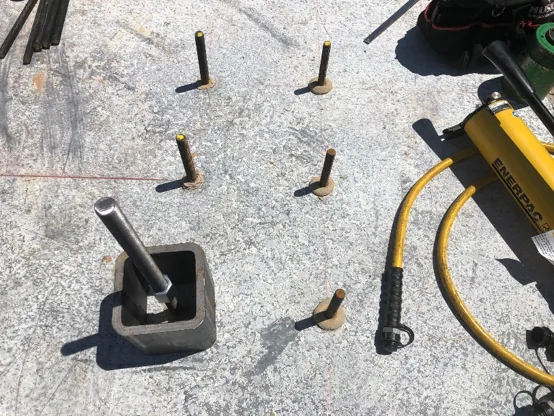
If your project is commercial construction under the IBC and you're installing post-installed anchors into hardened concrete, anchor bolt pull testing is mandatory. It is not optional, not a recommendation — it is code-required. IBC Section 1705.3 requires special inspection including tension testing for all post-installed mechanical and adhesive anchors. Every state in our service area — Georgia, South Carolina, Tennessee, and Alabama — has adopted the IBC, making this a legal requirement on every commercial project. The testing frequency depends on the application: 100% of structural anchors, 50% of nonstructural equipment anchors, 25% of adhesive shear dowels, and 10% of low-load anchors under 100 pounds design tension.
The short version: if an inspector is on your project and you've drilled into concrete to install anchors, expect them to be tested. The rest of this page walks you through the specifics — what triggers testing, what frequency applies, which state code governs your project, and the exceptions you should know about.
The Quick Decision
You Need Testing If:
Post-installed anchors (expansion, undercut, screw, or adhesive) in hardened concrete on any commercial, institutional, industrial, or multi-family project under the IBC. This includes equipment anchorage, structural connections, railing post anchors, and seismic restraints.
You Might Need Testing If:
Residential project with engineered anchor connections, local jurisdiction with stricter-than-IBC requirements, fall protection anchors on any building type (OSHA governs these regardless of building code), or existing building modifications requiring anchoring.
You Likely Don't If:
Detached one- or two-family dwelling or townhouse under three stories (IRC applies, not IBC). Cast-in-place anchors with visual inspection confirmation. Undercut anchors where proper set can be visually confirmed per the manufacturer's ESR.
Testing Frequency by Application
IBC Section 1705.3, Table 1705.3 establishes the minimum testing frequencies. These are the minimum requirements — the engineer of record may specify more stringent testing on any project. Test loads, acceptance criteria, and testing frequency must be shown on the approved construction documents.
| Application | Frequency | Inspection Level | Notes |
|---|---|---|---|
| Structural post-installed anchors | 100% | Periodic | All anchors tension tested. No exceptions for structural connections. |
| Nonstructural / equipment anchorage | 50% | Periodic | Alternate bolts in a group, including at least one-half the anchors in each group. |
| Adhesive dowels for shear transfer | 25% | Periodic | When 12 or more dowels are uniformly distributed across seismic force-resisting members. |
| Low-load anchors (<100 lbs tension) | 10% | Periodic | Design tension under 100 lbs, clearly noted on approved construction documents. |
| Sill plate bolting (expansion anchors) | 10% | Periodic | Per CBC/IBC amendments in applicable jurisdictions. |
| Adhesive anchors — overhead/sustained tension | 100% | Continuous | Inspector present during entire installation. Certified installer required per ACI 318 Section 26.7.1(l). |
| Cast-in-place anchors (ACI 318 strength design) | Visual | Periodic | Visual verification prior to concrete placement. Pull testing not typically required. |
| Fall protection anchors (all building types) | 100% | Per OSHA | 5,000 lbs or 2:1 safety factor. Recertification every 5 years per OSHA 1926.502(d)(15). |
If Any Anchor Fails
All untested anchors of the same type installed by the same trade must be tested until 20 consecutive anchors pass. Then the initial test frequency resumes. Read the full failure protocol →
Periodic vs. Continuous Inspection
Most post-installed anchor installations require periodic special inspection — the inspector checks in at intervals to verify materials, installation methods, and test results. Continuous special inspection — where the inspector must be present during the entire installation process — is required for adhesive anchors installed in horizontal or upwardly inclined orientations that resist sustained tension loads. This continuous requirement was added to the code after the 2006 Boston Big Dig tunnel ceiling collapse, where epoxy anchors supporting overhead concrete panels failed under sustained dead load.
The distinction matters for project scheduling and cost. Continuous inspection means the installer cannot proceed without the inspector on site. Periodic inspection means the installer works and the inspector verifies at defined intervals.
Certified Installer Requirement
ACI 318 Section 26.7.1(l) requires that adhesive anchors installed in horizontal or upwardly inclined orientations resisting sustained tension loads must be installed by a certified installer — not just any crew member. The ACI/CRSI Adhesive Anchor Installer Certification (AAIC) program includes both written and hands-on performance exams. The overhead installation simulation has a failure rate of approximately 50% — even among experienced installers. If your project has overhead adhesive anchors in sustained tension, verify the installer holds this certification before work begins.
State-by-State Requirements
Every state in our service area adopts its own edition of the IBC, sometimes with state-specific amendments that affect anchor testing. Here's what applies in each state as of 2026.
Georgia
2024 IBC w/ Georgia AmendmentsEffective January 1, 2026
Georgia jumped directly from the 2018 IBC to the 2024 IBC — skipping the 2021 edition entirely. This means contractors and inspectors are encountering updated special inspection requirements for the first time. Georgia also adopted the SEAOG Special Inspection Guidelines as a referenced standard, which provides detailed guidance on post-installed anchor testing procedures, inspector qualifications, and preconstruction meeting requirements.
Georgia amendments to Table 1705.3 include specific requirements for special inspection of post-installed anchors. Where specific requirements are not provided in the anchor's research report (ESR), the registered design professional must specify them and the building official must approve before work begins.
South Carolina
2021 IBC w/ SC AmendmentsCurrent adoption
South Carolina currently enforces the 2021 IBC through the SC Building Codes Council. Post-installed anchor testing requirements follow IBC Section 1705.3 without significant state amendments. The state requires periodic special inspection for all post-installed anchors in concrete per the base IBC provisions.
South Carolina has specific wind-force-resisting system inspection requirements that may trigger additional anchor testing for coastal projects in Charleston, Hilton Head, and Myrtle Beach areas where wind exposure categories are higher.
Tennessee
State-adopted IBCCurrent adoption
Tennessee adopts the IBC through the State Fire Marshal's office. Post-installed anchor testing follows the base IBC Section 1705.3 provisions. Tennessee's seismic hazard zones — particularly eastern Tennessee near Knoxville and Chattanooga — can push projects into higher Seismic Design Categories, which triggers additional special inspection requirements for anchors in seismic force-resisting systems.
Alabama
State-adopted IBCCurrent adoption
Alabama follows the IBC for commercial construction. Post-installed anchor testing requirements follow the base IBC Section 1705.3 provisions. Birmingham and Huntsville are the primary metro areas in our service territory. Local jurisdictions may have additional requirements — always verify with the local building department before starting anchor installation.
The Residential Exemption
Detached one- and two-family dwellings and townhouses not more than three stories above grade plane with a separate means of egress fall under the International Residential Code (IRC), not the IBC. The IRC does not require post-installed anchor pull testing as a standard requirement. However, this exemption is narrower than most people think — a four-unit apartment building, a mixed-use structure, or a townhouse over three stories is IBC territory and anchor testing applies.
Even on IRC-exempt projects, the engineer of record or local jurisdiction may require anchor testing for specific applications. And fall protection anchors are governed by OSHA regardless of building code — if roof anchors, tie-off points, or davit bases are installed on a residential project, they still need to meet the 5,000-pound capacity requirement and five-year recertification cycle.
Fall Protection Anchors — A Separate Requirement
Fall protection anchor testing operates under OSHA, not the IBC. OSHA 1926.502(d)(15) requires fall arrest anchors to withstand 5,000 pounds or maintain a 2:1 safety factor over the maximum intended load. This applies to roof anchors, tie-off points, davit bases, and engineered fall protection systems on any building type — commercial or residential. OSHA also requires recertification at least every five years, creating a recurring testing obligation for building owners.
This is a separate revenue consideration for building owners: even after the construction project is complete and all IBC-required testing is done, the fall protection anchors on that building will need to be re-tested every five years for the life of the system.
Code References
IBC 2024 Section 1705.3, Table 1705.3
Required special inspections and tests of concrete construction. Defines testing frequencies for post-installed anchors by application type and inspection levels (periodic vs. continuous).
ACI 318 Chapter 17 & Section 26.7.1(l)
Anchor design provisions and the certified installer requirement for adhesive anchors in horizontal/upwardly inclined orientations resisting sustained tension loads.
ASTM E3121/E3121M-17
Field testing standard for post-installed anchors in concrete and masonry. Defines proof load and ultimate load test procedures.
OSHA 1926.502(d)(15)
Fall protection anchor capacity requirements — 5,000 lbs or 2:1 safety factor. Governs all building types regardless of IBC or IRC applicability.
SEAOG Special Inspection Guidelines
Georgia-adopted referenced standard providing detailed guidance on special inspection procedures for post-installed anchors, inspector qualifications, and preconstruction meeting checklists.
Frequently Asked Questions
Not Sure What Your Project Requires?
Tell us about your project — anchor type, application, location — and we'll confirm the testing requirements for your specific situation. No guesswork, no surprises from the inspector.
Request a Quote Call (404) 860-1288