
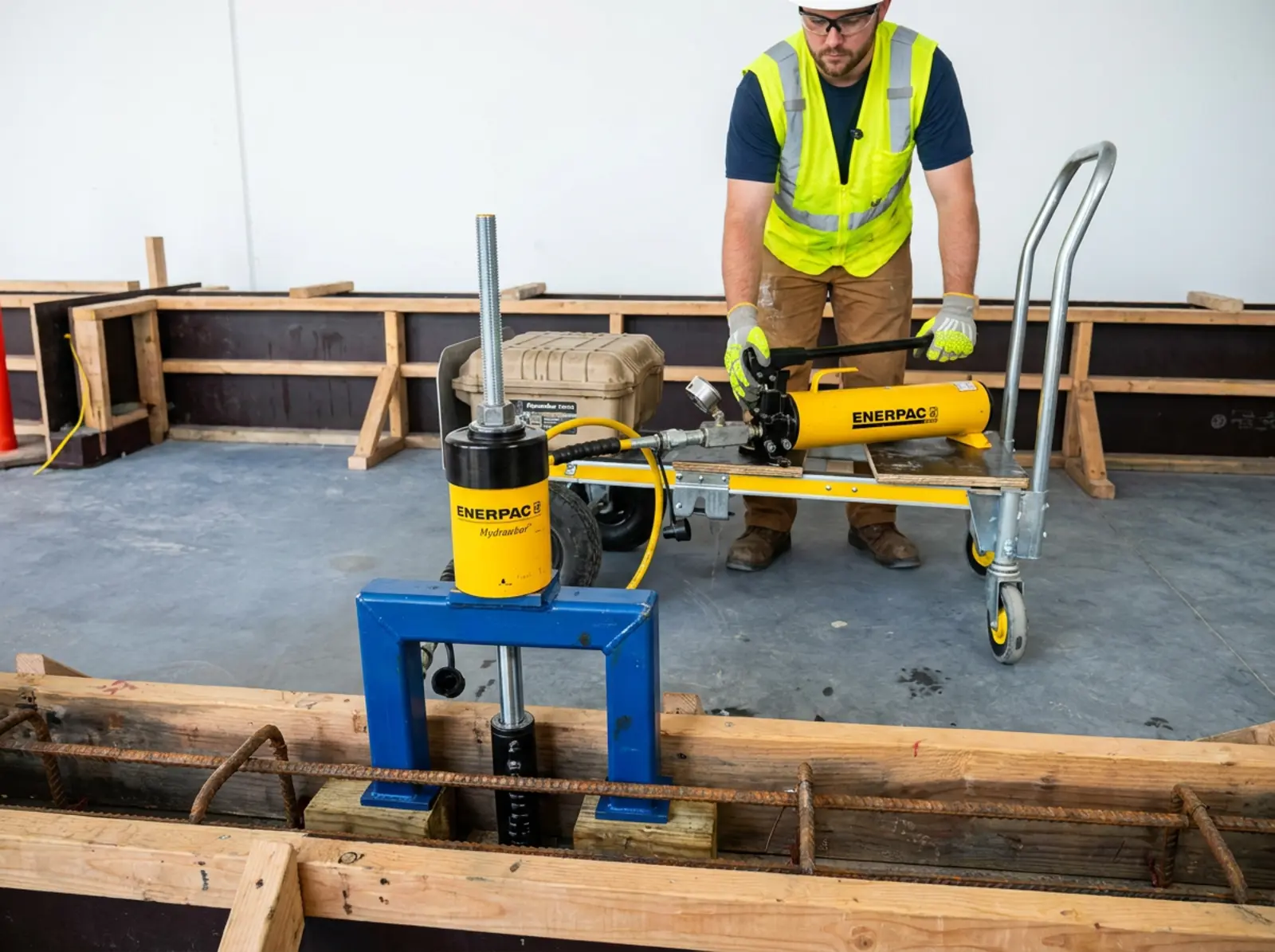
IBC 2024-Compliant Field Testing • ASTM E3121
Anchor Bolt Pull Testing Across the Southeast
Proof load testing, ultimate load testing, and post-installed anchor special inspections from our Atlanta hub — covering Georgia, South Carolina, Tennessee, and Alabama.
Testing Services
Anchor Testing for Every Application
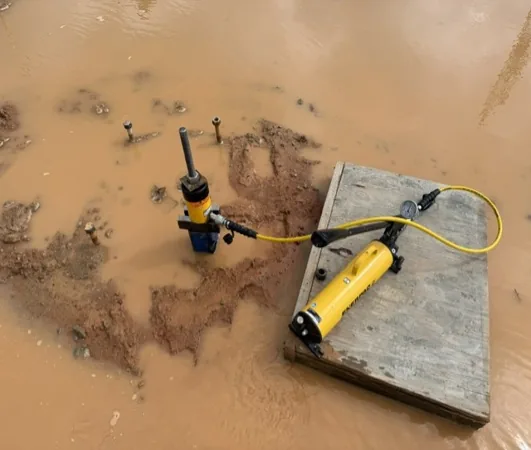
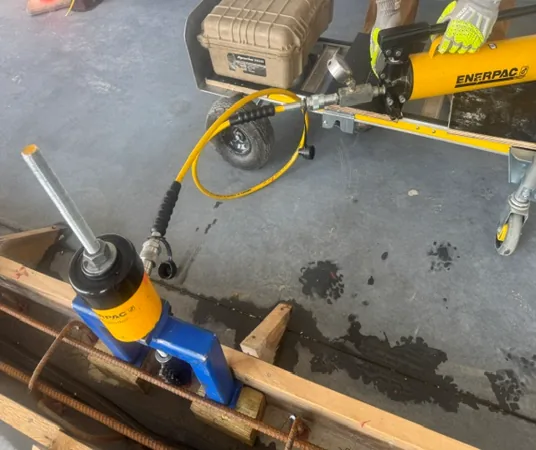
Field testing performed to ASTM E3121 with calibrated Enerpac hydraulic equipment and full documentation — from new construction to five-year fall protection recertification.
Proof Load Testing
Non-destructive testing to a specified percentage of design capacity. Load applied gradually, held minimum 15 seconds, monitored for movement. Anchor remains serviceable after test. Verifies proper installation of expansion, undercut, screw, and adhesive anchors.
Request Proof Load Test →Ultimate Load Testing
Destructive testing to failure for maximum capacity determination. Required for design data development, product qualification, and unknown anchor investigation. Results identify the governing failure mode — steel rupture, concrete breakout, pullout, or pryout.
Request Ultimate Test →Torque Verification
Non-destructive verification using manufacturer's recommended torque per the approved ICC-ES evaluation report. Code-permitted alternative for torque-controlled expansion anchors. Fast, effective confirmation of proper anchor set.
Request Torque Test →Fall Protection Anchors
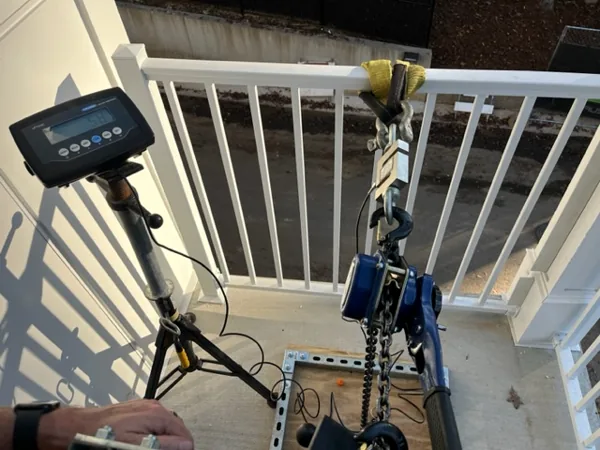
OSHA 1926.502(d)(15) requires fall arrest anchors to withstand 5,000 lbs or maintain a 2:1 safety factor. Recertification every five years. We test roof anchors, tie-off points, davit bases, and engineered systems to ANSI Z359.18.
Request Fall Protection Test →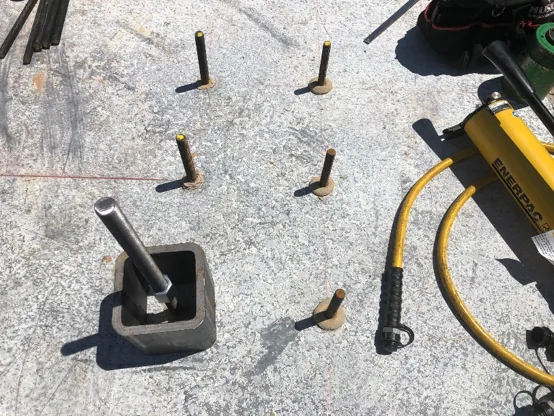
Codes & Standards
Testing Built on the Right Standards
Every test references the applicable ASTM standard, satisfies IBC special inspection requirements, and follows ACI design provisions. Documentation that holds up to plan review.
ASTM E3121
The field testing standard. Static tensile and shear testing of anchors in concrete or masonry. Proof load and ultimate load procedures for on-site verification.
View Standard →ASTM E488
Lab-grade anchor strength testing. Tension and shear in cracked and uncracked concrete. The base test framework for product qualification.
View Standard →ASTM F1554
Anchor bolt steel specification. Three grades — 36, 55, and 105 ksi yield. Covers straight, bent, headed, and headless bolts from 1/4" to 4" diameter.
View Standard →ACI 318 Chapter 17
Anchor design provisions. Five failure modes evaluated: steel rupture, concrete breakout, pullout, side-face blowout, and pryout. Defines phi factors and breakout cone geometry.
View Standard →IBC 2024 §1705.3
Special inspection requirements for post-installed anchors. Periodic inspection minimum. Georgia adopted this edition January 1, 2026 — jumped directly from IBC 2018.
View Code →OSHA 1926.502
Fall protection anchor standard. 5,000 lb capacity or 2:1 safety factor for fall arrest anchors. Recertification every five years for all certified anchorage points.
View Regulation →IBC Section 1705.3
What Percentage of Anchors Need Testing?
Testing frequency depends on the application, anchor type, and design load. These are the minimum IBC requirements — the engineer of record may specify more.
Structural Applications
All post-installed structural anchors must be tension tested. No exceptions for structural connections.
Nonstructural / Equipment
Alternate bolts in a group, including at least one-half the anchors in each group.
Adhesive Dowels (Shear)
When 12 or more dowels are uniformly distributed across seismic force resisting members.
Low-Load Anchors
Design tension under 100 lbs, clearly noted on approved construction documents.
Source: IBC 2024, Chapter 17 — Special Inspections and Tests, Table 1705.3
ACI 318 Chapter 17
Five Ways an Anchor Can Fail
Every anchor design must evaluate these failure modes. Which mode governs determines the correct test method, proof load calculation, and whether confined or unconfined testing is required.
Steel Rupture
DuctileBolt fractures under tensile load. The preferred failure mode — gives visible warning. φ = 0.75.
Concrete Breakout
BrittleConcrete fractures in a cone at ~35° from anchor head. Most common governing mode. Cone radius = 1.5 × hef.
Pullout
BrittleBearing pressure exceeds concrete crushing strength. Anchor slides out without fracturing bolt or cone.
Side-Face Blowout
BrittleConcrete splits laterally near edges with deep embedment. Occurs when hef > 2.5 × edge distance.
Concrete Pryout
BrittleHigh shear forces pry out concrete behind the anchor. Governs short, stiff anchors under lateral loads.
Service Area
Atlanta Hub. Four-Hour Radius. Four States.
Mobile anchor bolt testing from our Atlanta base. Each city page references the correct state code edition and local building department requirements.
Georgia
2024 IBC w/ Georgia Amendments
Atlanta • Savannah • Macon • Augusta • Athens • Columbus • Valdosta
One Preventable Failure Changed Everything
In 2006, 26 tons of concrete ceiling panels fell in Boston's Big Dig tunnel — killing a passenger — because epoxy anchors were never properly tested for long-term creep. Massachusetts banned epoxy anchors in overhead applications. The tragedy reshaped anchor testing requirements nationwide.
Read the Full Case Study →Common Questions
Anchor Testing FAQ
Who’s Behind the Testing
Xenogenesis, LLC
All anchor bolt testing is performed by Xenogenesis, LLC — an NDT and inspection company based in metro Atlanta with decades of field experience across the Southeast.
Timothy Dodd
AWS CWI #00120381 • ICC S2 #8184186
AWS Certified Welding Inspector and owner of Xenogenesis, LLC. Performs all field testing and inspection. Reviews all technical content on this site for code accuracy. Credentials verifiable through AWS and ICC.
Roger Baldwin
Site Owner & Operator
Owner and operator of AnchorPullTest.com. 28 years in the broader nondestructive testing industry, including 20 years operating a ground-penetrating radar and NDT imaging company. Handles business operations and partners with Timothy Dodd for all inspection and technical content review.
Get Started
Request a Quote
Tell us about your project and we will respond within one business day with availability and pricing.
Phone
(404) 860-1288Response Time
Within 1 Business Day
Calibrated Enerpac hydraulic equipment • Full documentation for plan review • IBC-compliant testing procedures
Quote Request Received
We will respond within one business day with availability and pricing for your project.