
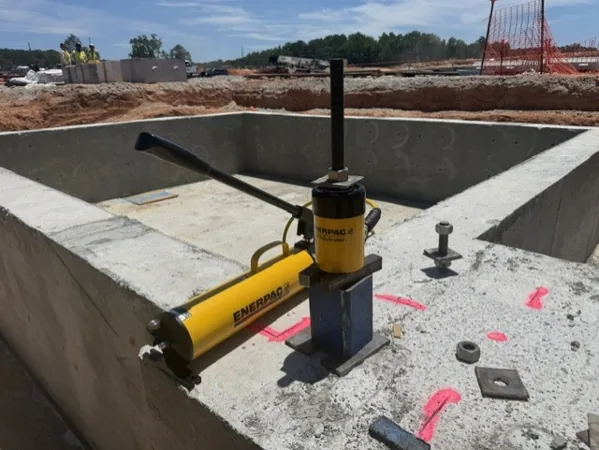
Anchor bolt pull testing is mandatory on Georgia building projects today because of a regulatory path that spans three decades — from the 1991 Uniform Codes Act that first gave Georgia statewide building codes, through a deadly tunnel collapse in Boston that rewrote national anchor testing standards, to the 2024 IBC adoption that represents the most comprehensive special inspection requirements in state history. Understanding this history matters because it explains why the current requirements exist, not just what they are.
Before 1991: No Statewide Building Codes
Before October 1, 1991, Georgia had no mandatory statewide building codes. Each city and county decided whether to adopt a building code at all, and which one. Some jurisdictions adopted the Standard Building Code (SBC) published by the Southern Building Code Congress International (SBCCI) — the dominant code in the Southeast. Many rural counties had no building code enforcement at all.
This meant anchor bolt testing requirements were entirely local. A post-installed anchor on a project in Atlanta might require inspection under the city's adopted SBC provisions; the same anchor installation 30 miles away in an unincorporated county might have no inspection requirement whatsoever.
1991: The Uniform Codes Act Changes Everything
On October 1, 1991, Georgia's Uniform Codes Act took effect — the single most important date in the state's building code history. For the first time, Georgia established mandatory statewide construction codes that applied to all construction regardless of whether the local government chose to enforce them.
The Act created two categories:
Mandatory State Codes
Applied to all construction statewide. Local governments could choose whether to enforce them, but the codes themselves applied to every project. The initial mandatory codes included the Standard Building Code (SBC) and companion codes for mechanical, plumbing, gas, fire, and electrical.
Permissive State Codes
Applied only if a local government chose to adopt and enforce them by ordinance. These included property maintenance, existing building codes, and later additions like green building standards.
The 1991 Act also created the Department of Community Affairs (DCA) Construction Codes Program and what would become the State Codes Advisory Committee — the bodies that still manage Georgia's code adoption process today.
At this stage, the SBC included general special inspection provisions, but post-installed anchor testing was not yet a distinct, explicit requirement. The technology of post-installed anchoring was still evolving, and the code language had not yet caught up.
2002: Georgia Adopts the International Building Code
In 2002, Georgia took the next major step: adopting the 2000 International Building Code (IBC), effective January 1, 2002. This marked Georgia's transition from the regional Standard Building Code to the nationally recognized IBC system published by the International Code Council (ICC).
The 2000 IBC included Chapter 17 — Structural Tests and Special Inspections — which for the first time gave Georgia a standardized framework for requiring special inspections on structural elements, including anchors. However, the 2000 IBC's anchor provisions were still relatively limited compared to what would come later.
Why Chapter 17 Matters
IBC Chapter 17 is where anchor bolt testing requirements live in the code. Every subsequent code adoption in Georgia has refined and expanded this chapter — adding more anchor types requiring inspection, specifying inspection frequency (periodic vs. continuous), defining inspector qualifications, and referencing updated testing standards like ASTM E3121.
2004: Building Codes Become Truly Mandatory
While the 1991 Uniform Codes Act made codes applicable statewide, enforcement remained optional for local governments that chose not to staff a building department. In 2004, Georgia strengthened the framework by requiring that all jurisdictions issuing building permits must enforce the state minimum codes. This closed a gap that had allowed some construction to proceed without code-compliant inspection even though the codes technically applied.
2006: The Big Dig Collapse — A National Turning Point
On July 10, 2006, a 12-ton section of concrete ceiling panels collapsed in Boston's Interstate 90 connector tunnel — part of the infamous "Big Dig" project. The collapse killed motorist Milena Del Valle and injured her husband.
The NTSB investigation found the cause was epoxy creep failure in the adhesive anchors holding the ceiling panels to the tunnel roof. The epoxy anchors, subjected to sustained tensile loading over years, had slowly pulled out of the concrete. The investigation revealed that the design had not adequately accounted for the long-term creep behavior of the adhesive under sustained load.
The Fallout Was Massive
The Big Dig collapse resulted in $458 million in settlements, criminal charges, and a complete reexamination of how post-installed anchors — particularly adhesive anchors in sustained tension — were designed, installed, and inspected nationwide. It was the single most significant catalyst for the modern anchor testing requirements that Georgia enforces today. Read our full Big Dig case study →
The Big Dig didn't change Georgia's code directly — it changed the national model codes that Georgia adopts. The code changes that followed rippled through the 2009 and 2012 IBC editions, transforming anchor testing from a general structural inspection item into a detailed, specific set of requirements.
2007–2012: The Post-Big Dig Code Revolution
The years following the Big Dig collapse produced the most significant changes to anchor testing requirements in code history:
Georgia Adopts 2006 IBC
Effective January 1, 2007, Georgia adopted the 2006 IBC with Georgia Amendments. This was the last IBC edition written before the Big Dig collapse, but it already included Chapter 17 provisions for post-installed anchor inspection. This was the first time Georgia had a clear, IBC-based framework for anchor bolt testing as a mandatory special inspection item.
2009 IBC Expands Anchor Inspection
The 2009 IBC — the first edition written after the Big Dig — significantly expanded post-installed anchor special inspection requirements. Continuous inspection was now required for cast-in anchors designed under ACI 318 Appendix D strength design procedures. Section 1704.1 also required the owner or their registered design professional to hire approved inspection agencies — not the contractor. Georgia skipped this edition entirely.
ACI 318 Adds Certified Installer Requirement
ACI 318-11 Appendix D introduced the certified installer requirement for adhesive anchors resisting sustained tension in horizontal or upwardly inclined orientations — a direct response to the Big Dig failure mode. Installers now needed manufacturer certification, and adhesive anchors in these critical applications required documented proof of installer qualification.
2012 IBC Refines Inspection Levels
The 2012 IBC adjusted the inspection framework: cast-in anchor inspection was reduced to periodic (recognizing its similarity to reinforcing steel inspection), while post-installed anchors in hardened concrete were listed in Table 1704.4 as requiring periodic special inspection. The distinction between periodic and continuous inspection was also clarified. The SEAOG published its first Georgia-specific special inspections guidelines around this period.
Georgia Adopts 2012 IBC
Effective January 1, 2014, Georgia adopted the 2012 IBC — its first adoption of a post-Big Dig code edition. This was the moment when the expanded anchor testing requirements became Georgia law. Contractors, engineers, and inspectors across the state were now operating under requirements that had been fundamentally reshaped by the Boston tunnel collapse eight years earlier.
2020–2026: Modern Requirements Take Shape
Georgia Adopts 2018 IBC
Effective January 1, 2020, Georgia adopted the 2018 IBC with Georgia Amendments — again skipping an edition (the 2015 IBC). The 2018 edition continued the pattern of refining Chapter 17 special inspection requirements and included updated references to ASTM E3121 as the field testing standard for anchors in concrete and masonry.
SEAOG Guidelines Updated
The ACEC/SEAOG SI GL 01-2024 Georgia Special Inspections Guidelines were published, providing detailed implementation guidance for Chapter 17 special inspections in Georgia — including specific procedures for post-installed anchor testing, inspector qualification requirements, and preconstruction meeting protocols.
Georgia Adopts 2024 IBC
Effective January 1, 2026, Georgia jumped from the 2018 IBC directly to the 2024 IBC — skipping the 2021 edition and absorbing six years of code changes at once. Georgia Amendments IBC-2024-14 and IBC-2024-15 established the SEAOG Guidelines as an authorized reference standard and set minimum inspector qualification requirements. This is the most comprehensive anchor testing framework Georgia has ever enforced. See our detailed breakdown of the 2024 IBC changes →
Why This History Matters for Your Project
Understanding why anchor bolt testing requirements exist isn't just academic — it changes how you approach compliance on your project:
The Requirements Are Not Arbitrary
Every anchor testing requirement in Georgia's current code exists because of a documented failure, a structural collapse, or an engineering lesson learned the hard way. The Big Dig collapse alone cost over $458 million in settlements and one life. The code requirements that followed were written specifically to prevent that failure mode from recurring.
Georgia's Skip Pattern Creates Gaps
Georgia has skipped every other IBC edition (2009, 2015, 2021), which means each adoption brings multiple code cycles of changes at once. Contractors and engineers who were current on the 2018 IBC are now navigating six years of updates with the 2024 adoption. This makes staying ahead of requirements more critical than in states that adopt each edition.
SEAOG Guidelines Add Georgia-Specific Teeth
Unlike most states that rely solely on the base IBC, Georgia now has its own SEAOG Special Inspections Guidelines authorized as a reference standard. These provide implementation details the base code doesn't — including specific procedures for how anchor testing must be documented, who qualifies as an inspector, and what a preconstruction meeting must cover.
The Trend Is Toward More Inspection
Every major code revision since the Big Dig has expanded — not reduced — anchor testing requirements. Inspector qualifications have tightened, documentation has become more detailed, and the scope of what triggers a special inspection continues to grow. Project teams that plan for this trajectory avoid costly compliance surprises.
Where Requirements Are Heading
The trajectory of anchor bolt testing regulation in Georgia points clearly in one direction: more oversight, not less. Several trends are already shaping the next cycle of requirements:
- Digital documentation — Georgia already recognizes digital Statements of Special Inspections (SSI) under the 2024 IBC. Expect digital reporting to become the standard, not the exception, within the next code cycle.
- Tighter inspector qualifications — Georgia Amendment IBC-2024-15 established minimum inspector qualification requirements. Future editions will likely require specific anchor testing certifications beyond general special inspector credentials.
- Expanded adhesive anchor oversight — Post-Big Dig requirements for adhesive anchors in sustained tension continue to evolve. The certified installer requirement is already expanding to cover more installation scenarios.
- Standardized testing procedures — ASTM E3121 is becoming the universal field testing standard, replacing the older ASTM E488 for field applications. Georgia's adoption of the 2024 IBC ensures E3121 compliance is the baseline.
Code References & Source Documents
DCA Code Adoption History
Complete timeline of every mandatory and permissive code adoption in Georgia from 1991 to present.
DCA Mandatory & Permissive Codes
Current list of all mandatory and permissive state construction codes in Georgia.
About Georgia Construction Codes
DCA overview of how Georgia's construction codes program works, including the State Codes Advisory Committee.
SEAOG Special Inspections Guidelines
The ACEC/SEAOG SI GL 01-2024 Georgia Special Inspections Guidelines — Georgia's authorized reference for Chapter 17 implementation.
ICC Georgia Adoption Map
International Code Council's adoption status page for Georgia, showing current code editions in effect.