
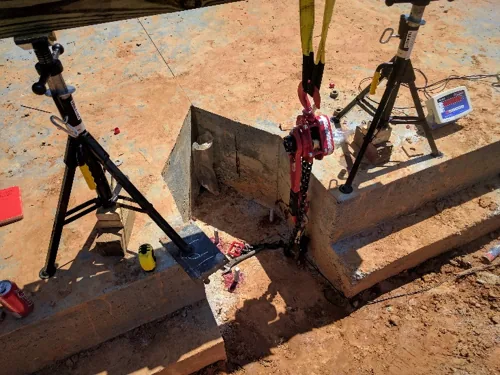
Anchor bolt pull testing requires a center-hole hydraulic cylinder placed over the anchor, a hydraulic pump to apply controlled load, a calibrated load cell or pressure gauge to measure force, and a bridge plate or reaction frame to transfer the load to the concrete. We use Enerpac hydraulic systems — the industry standard for field anchor testing — with calibrated digital readouts and bridge plates sized for both confined and unconfined test configurations.
How the Test System Works
Every anchor pull test uses the same basic system regardless of anchor type, size, or application. The components work together to apply a controlled tensile force to the anchor and measure the result.
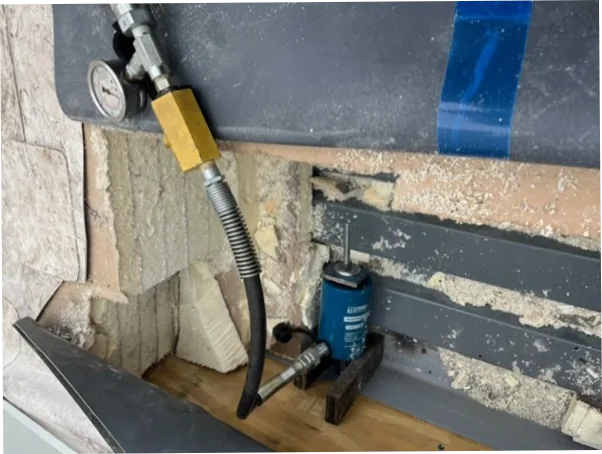
Center-Hole Hydraulic Cylinder (Ram)
The Enerpac center-hole cylinder sits over the anchor bolt with the threaded rod passing through the center. As the pump pressurizes the cylinder, the ram extends upward, pulling the bolt in tension while the cylinder body pushes down against the bridge plate. This opposing force is what loads the anchor. Enerpac cylinders are available in capacities from 10 tons to over 100 tons, matched to the proof load requirement.
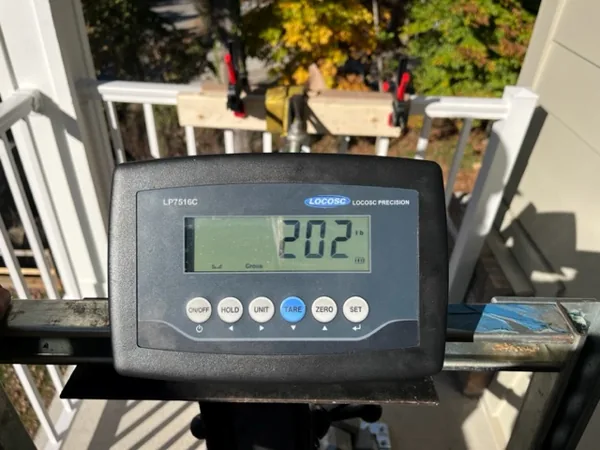
Calibrated Load Cell & Digital Readout
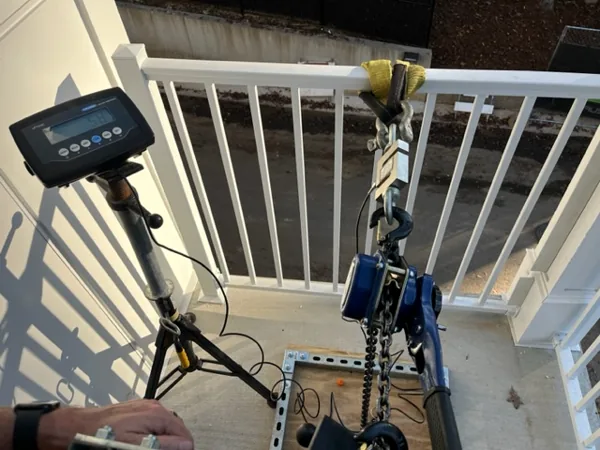
The load cell measures the exact force being applied to the anchor in real time. Digital readouts display the load in pounds or kilonewtons with precision that analog gauges can't match. All load cells must be calibrated and traceable to national standards — calibration certificates are included in every test report. The readout shown here displays 202 lbs during a railing load test.
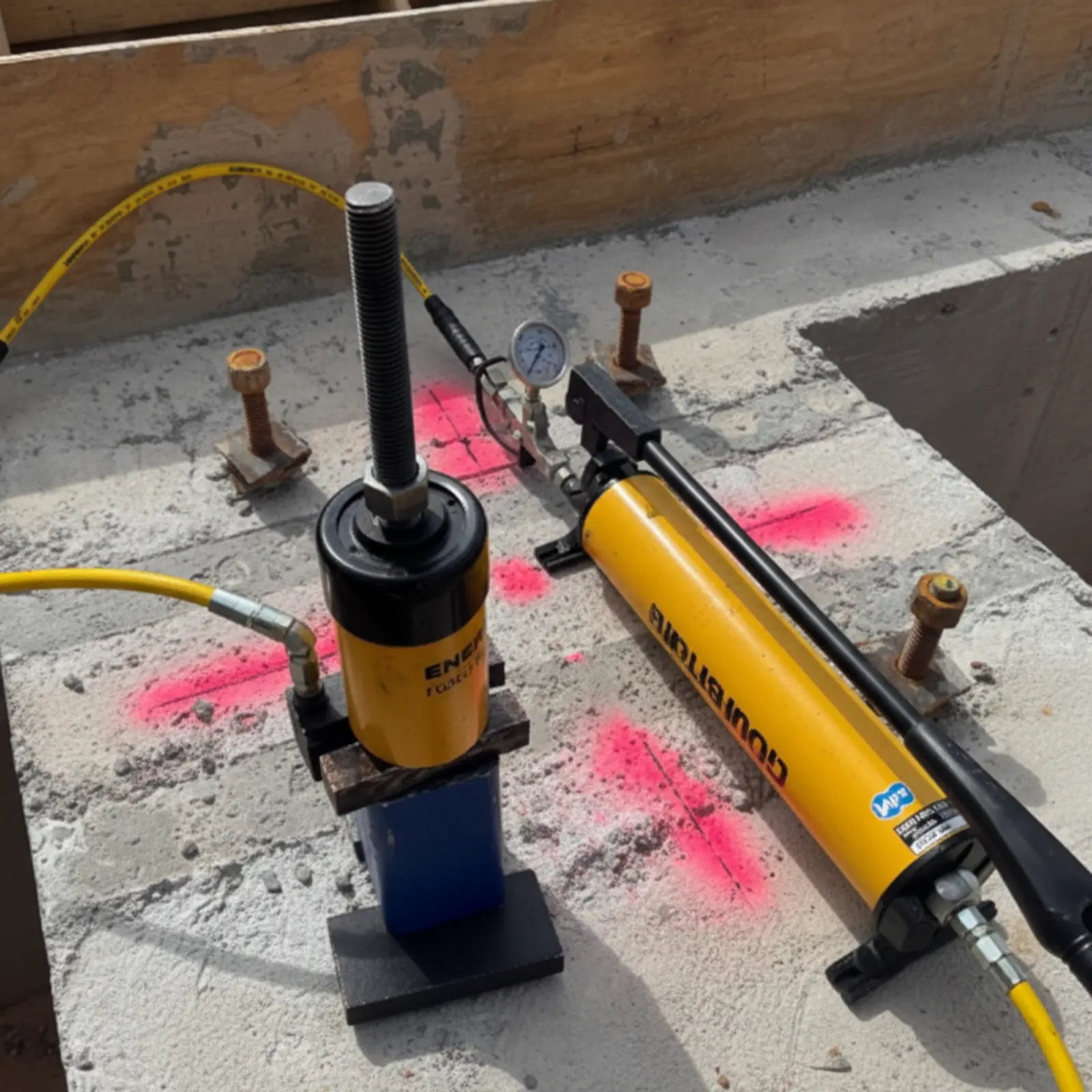
Hydraulic Hand Pump
The hydraulic hand pump delivers controlled pressure to the cylinder. Load is applied gradually — per ASTM E3121, the test load should be reached in approximately 30 seconds after a 5% pre-load is applied to bring all components into full bearing. The hand pump gives the operator precise control over loading rate, which is critical for detecting movement during the load hold.
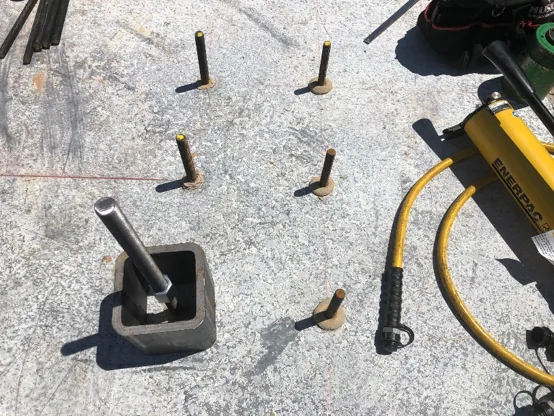
Bridge Plate / Reaction Frame
The bridge plate spans across the anchor and transfers the cylinder's downward reaction force to the concrete surface. For unconfined testing, the bridge plate must be long enough to place its feet at least 1.5 times the embedment depth from the bolt center — ensuring the breakout cone can develop without being suppressed. Bridge plates are available in multiple lengths to accommodate different embedment depths and test configurations.
Built for Field Conditions
Anchor pull testing happens on active construction sites — not in laboratories. The equipment needs to handle mud, rain, tight spaces, overhead positions, and concrete that's still curing. Here's what real testing looks like in the field.
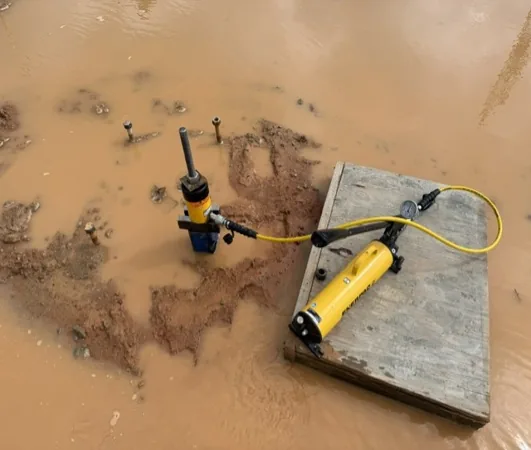
Testing doesn't stop for weather. Muddy conditions, wet concrete, and tight access are normal.
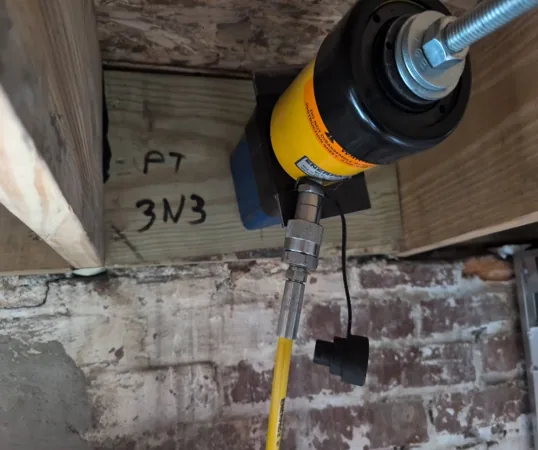
Overhead and elevated testing with equipment adapted for vertical and inverted positions.
Lateral and shear testing on masonry walls using adapted reaction frames.
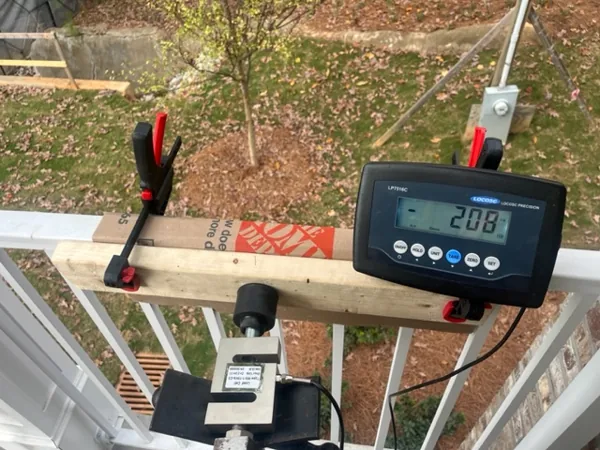
Railing and guardrail load testing using chain hoists with calibrated load cells — 200 lb concentrated or 400 lb proof load per IBC.
Calibration & Documentation
IBC and ASTM E3121 require that all testing equipment be calibrated and traceable to national standards. Calibration is performed annually by an accredited laboratory. Every test report we produce includes the equipment serial numbers, calibration dates, and calibration certificate references. If the building official or special inspector requests calibration documentation, it's available immediately.
Test reports also include the test date, anchor type and size, embedment depth, concrete strength, test load achieved, load hold duration, observed movement (if any), failure mode (if applicable), and pass/fail determination. This documentation is what satisfies IBC Section 1705.3 special inspection requirements and supports the engineer of record's acceptance of the anchor installation.
Frequently Asked Questions
Need Anchor Pull Testing?
Calibrated Enerpac equipment, IBC-compliant procedures, and full documentation for your inspector and engineer of record. We test across the Southeast from our Atlanta hub.
Request a Quote Call (404) 860-1288